Kinesthesia https://www.inkitt.com/stories/1549364
Kaleidoscope by Erika
Delicious bite-size stories
about
-
There was no time for all of that. She had disgraced her family, disgraced herself, and here she was: two kids, absent husband, making a muck of it all.
Could you imagine that there is a place in Italy whose name, translated, means “eagle”? Mandy didn’t want to say the real name of the place, hoping maybe it would disappear, invisible again as it was before she knew of its existence.
Maybe, deep down, she thought that her family of origin would have saved her, swooped her up and wiped her tears. Instead, she had been branded as the black sheep and kicked out(8 months pregnant, no less) and basically disowned. Then again, no one had told her to marry an Italian with no university education. She had collected a variety of boyfriends from across the globe and in the end, they had stopped caring. She was not presentable. Perhaps, as well, she had been arrogant. But under that was a little girl waiting to be loved and comforted.
The city was in a bowl-shaped geologic formation, caged in by barren hills and, from a distance, sunk below mighty peaks of the Alpennine, the mini Alps in the region of Abruzzo.
But when Mandy came, she realized she was not wanted. Her mother-in-law, clearly, spoke no English. And judging by her expression while she spoke Italian, she didn’t care much for Mandy. After all, Mandy didn’t know how to make gnocchi or iron underwear. She even said that her sons didn’t resemble her husband (the implications of which were clear, she understood that when she began to speak Italian better).
The dim realization of having made a terrible mistake began to dawn on her as she prepared spaghetti in a mumu in the blinding heat of August. What had she done? From San Diego California to this? Of course in San Diego it had been rough. They had trouble finding a rental apartment and had spent the first evening after giving birth literally in a homeless shelter. It was terrifying, even though there was food and a bed. Thankfully after that they had found an apartment and she had made good with her two small children (one just born), pushing the stroller for Denver with Rob strapped to her chest, going to Balbao Park, in line to see Santa Claus, to doctor appointments…but in the end Antonio had pushed her to consider going to Italy. At least they would have help, and she had to admit they needed it. She would be alone in California raising the kids. So they took the plane and came. On their side of the aircraft, there were people dressed in black, mourning an unknown relative. So much for good luck charms, she thought.
In Italy Mandy had no one to rely on except her mother-in-law, who was a good woman at heart, but terribly stubborn. She wasn’t about to make it easy for Mandy to spread her wings. She was only interested in her “tesori” as she called the kids, Rob and Denver.
Mandy did her best, but the desolate feelings did not stop, only grew. She knew her family wanted nothing to do with her and she didn’t blame them, but her future seemed so terribly bleak, so poor. She had no possibility to work, as when she found some possibility, her husband Antonio promptly squelched such ideas, backed up by his mother’s tense frown.
“What’s the point? You will just have to pay a babysitter.” Her husband was so different now. She stared at his handsome face. Just because he looked like a dark-haired Latin lover she had thrown away a bright future. She had met him in a four-story bookstore in Colorado, for God’s sake! And he didn’t be even have a high school diploma, whereas she had read Silvia Plath and Anaïs Nin as a teenager, and her parents had friends in Hollywood. Once opportunities pass, it’s useless to look to the past. But she did, and the pain of it hurt her chest as she prepared the little soups of broth (onion, carrot, and celery) her MIL insisted she make. Her younger son, sick of swallowing that very soup, had thrown a bowl of it against the wall one day. Mandy had trembled inside, feeling sick with the rage and desperation which welled up in her. She was in the depths of post-partum depression, but had no one on her side.
She had fallen for a handsome Italian who was good with his hands and better with doing a disappearing act. He worked putting down wood floors and restoring doors and windows and had variable hours. For now, it seemed she was married to his mother, Genoveffa.
Not that it was all in vain. The older woman doted on her grandsons, and Mandy did learn quite a bit about making soup and “crispelle” a local type of pancake, which, rolled up, were filled with Parmesan and eaten in beef broth. She helped Mandy, certainly, getting the kids washed and dressed and vaccinated and all, but Mandy lost her sense of purpose. She had lost her capacity to think out of the box, seemingly stained with childbirth instead of being celebrated for it.
She began to realize that “Genny” was a victim of circumstance, and in the end, when Mandy thought of Genoveffa at sixteen in love with a debonair soldier, she couldn’t help but admire her tough demeanor and the way she never gave an inch, because she realized that she as well had taken the bait, mothering four children. Of course, it was a labour of love, but it seemed like a death sentence at the moment. No freedom, no happiness, only soup-making, diaper changing, cooking and cleaning. Outings only with the children. Romance nil.
So even though Mandy hated her mother-in-law, in some way she sympathized with her as well.
She became a soldier of eternity, fighting for her little kids, who clung to her in an underground bunker (no, that was a basement apartment) and she gave them everything she could. Unfortunately, Antonio left her only a little money, and she had no access to his bank account. Going to the store, she had to put things back on the shelves, otherwise she wouldn’t be able to pay. Since he didn’t have to live this with her, he didn’t care much and gave her the bare minimum. When she needed help, his parents stepped in, but naturally their sense of entitlement grew proportionally. In the end, the earthquake changed her life, in a sense for the positive.
“Earthquake vacation”… What a paradox!
But that was what happened, after the ground shook, after the dry flowers in the pot were shaken on to the floor, after the chunk of concrete was thrown down in front of the school entrance. More than 300 people died, it is true, and the whole family escaped to a town near the sea, where Antonio’s uncle lived. As well, there, she had problems as she had to deal with Genoveffa every day in close quarters, but finally after months, they moved back to the mountains and Mandy and the kids stayed in Vasto. She was alone, but she was free. There, she would find work, she would begin to assert her independence again, fighting against a crippling sense of uselessness, of despair. Fighting against the everyday tedium of taking care of kids, nursing them back to health, rescuing kittens and water turtles, burying elderly birds, dragging little kids to school.
Finally she escaped that grey town and moved to paradise, where the bougainvillea blooms and the air is soft and where grapes and olives grow.
And she would find a love, one that would set in her free, to live a life of devastating passion, a revenge of lust and fire, burning away years of isolation, fear, abuse, degradation and self-denial. And her roar would continue, as she fought her way to independence…
-

I remember the flattened leaves on the wet pavement, I remember thinking I would never see my son again. I remember thinking Rob was gone forever, I remember running, running, and wondering if I could manage to be alive in a world without him. I started thinking about everything that had come before, and led up to one of the most terrifying and disastrous moments of my life.
Epochs of rain. Eons of rain. The rain came down in sheets that night. I had given up all hope, when, thankfully, (and I had never been so happy to see the cops before in my life), I saw that they had found my son, they were taking him to the hospital, full of scratches and bruises but at least alive. He hadn’t even stopped after he had thrown himself out of the first floor window, falling through a shack below and by little missing a large pillar of cement. When he finally was stretched out at the hospital, he asked me “che devo fare?” (What should I do?). He couldn’t even cut himself a break after jumping out of a window. He couldn’t be tender with himself. Like many times during his life, I started to believe in angels. Once he told me he hadn’t looked before pulling out into the street with his bike, and a car had clipped him on his ear. (Dumb luck)
Sometimes, looking back, I feel like I had seen it all coming, like his childhood had passed before me like a terrible cross between a lucid dream and a nightmare. Sitting at that little park in that medium-sized, cold Italian city, waiting for his bike to lose the chain the way it always did, cloaked in the loneliness of a mom very far from home, I saw him do a 360 over the handlebars of his bike, in my mind that is, but so real. Years later, it actually happened. I can’t say that I am psychic, simply that I have a special connection to him. When I talk to him now, once a week when he is allowed to call, he often seems himself like my therapist “How are you mom? Are you ok?” I myself have been prone to strange bouts of manic activity, hyper sexuality, drug use, and even run-ins with the law as a young woman. Did I have a psychotic episode? Or was I just a terrible person? Back in the day there may have been less awareness of mental illness. I had been diagnosed as bipolar, but had flushed the pills down the toilet and continued to self-medicate on weed. Had I had a bad childhood? Not really, certainly eclectic, unstable, bizarre, with divorced parents and a choreographer mother, but certainly not abusive. Perhaps, though, there was a lack of attention, of validation which is needed in adolescence, an acceptance that my feelings of abandonment and sadness were real. I was considered an intelligent child, so I was simply told to achieve, be the best, and go on. Not that there is anything wrong with that. My father had been raised by first generation immigrants and certainly would not necessarily give into to emotional comforting. I always felt like I had to be number one, and once I saw him only twice a month, that stress heightened. Or maybe, simply, I needed him more than I realized at the time. Everyone needs a father. I had a very inspiring one, but certainly, after my parents separated, he became colder and more demanding, more critical. And I felt rejected, on a very intimate level. At the time, however, those feelings were squashed down until they exploded into my young adult life, when I started pushing my family away and indulging myself in every possible way: through low-level recreational drugs, strange boyfriends (one of whom might have been schizophrenic himself), and mystical flights of fancy, which resulted in me never finishing university and ending up with two young children and an Italian husband married on a whim, much to the consternation of my entire family. My father’s anger and disappointment were the heaviest however, and perhaps I carried this sense of shame and guilt to my own children.
Rob had been a fierce child, a tender child, a very tough little boy. And a very sensitive one. And looking back, I realized that he had been so scared, so alone. If I hadn’t been so wrapped up in my own problems, I would have stopped everything and tended to his. But sometimes life poses insurmountable challenges, so I don’t want to punish myself. I want to try to tell what I imagine to be his story from his point of view, even though some may say it’s impossible to penetrate through the eyes of another. A couple of times, I felt like we were one and the same. That his feeling of terror and anxiety was mine, when unexplained feelings devastated me, which (who knows?)may have been the same as his.
I remember when he didn’t want to go to school. A strong boy, running away from me his aunt and his grandma, he eventually stopped running and we had to take him home again to be changed. He was terrified to go to school, more than simply lazy. He missed his grandma. And he had written a letter to Jesus saying that his father and I fought all the time and he wanted to go back to his grandparents. We chased him over the railroad tracks, and looking back, I realized now that I was caught between wanting to be the sensitive, kind mom and the one who motivated him and pushed him along to be better. I had thought he was simply being a truant, a naughty little boy. I didn’t realize, I still don’t realize, what it means to suffer mentally the way he was.
There had been an earthquake. Many in fact, over the month before the big one which killed more than 300 people, and my sons were attending a school which was in the center of the city and very old. If it had come at night, everyone said, there would have been many more children dead. Luckily (if we can say that), it happened at night, and me and my family were in the car, feeling the strange and terrible sensation of the earth roiling up from within, sending waves of panic and death all around, screams and misery and fear. All that I had kept within was coming out (that was how it felt). All of my terrible emotions of being inadequate, failing my family, being nothing and nobody had exploded out in this earthquake, into plain sight. Somehow this tragedy made it impossible to run and hide anymore.
As a result, we moved to a coastal town (actually escaped at first, with the whole family, including their grandma in her pyjamas), and I stubbornly refused to move back, because I didn’t want to be all absorbed anymore into their family, where I was stuck under the overbearing reign of their grandma, who refused to be convinced of anything other than her own way. I stayed in the house in that town near the sea, even though my landlord was a beast of a man and lived upstairs and I had no one to help me with the kids, and no car. I wanted to do it alone. But for the children, it was hard.
Rob.
I saw it all, I could see that I wasn’t wanted. When I came to class, the students snickered, especially when I was wet from the rain, as mom didn’t have a car and we had to walk to school every day. No one talked to me, except for one other boy who turned out to be my best friend. I had so many lonely times, and my mom didn’t understand, she just wanted me to do my homework, do the best I could, carry on.
But she and my dad were always fighting. They hated each other.
It was all my fault, maybe if I hadn’t been born, they would have been happy. I was nothing to them, and finally, the sky started to talk to me, and it told me that everything was my fault, that there was nothing I could do but die, because I wasn’t loved, and I wasn’t wanted, and it was the reason why I would go so many miles on my bike, to be alone with the trees and the wind and the sun, to see the beauty that no one in the world seemed to see.
I loved mom. So much. But she didn’t understand me. My brother was a good student, well-liked, popular, while I was mostly excluded and left alone by the other kids it hurt me so much, that I would secretly cry, or sometimes I would be so angry that I would scratch and punch my brother just to ease the pain. He was always loved, and I was always the loser… Why?
My mom? She wasn’t happy. Dad was usually away, and she didn’t have the time or money to really enjoy herself. We had no car so we just wandered around, the three of us, buying candy as it was the cheapest thing. She was a good sport, playing games with us and making crepes at 3 am. But I knew she felt sad the way I did. She felt like my father had forgotten about us. And that we were useless, to him and to everyone.
And sometimes, when he came home, he smacked me. Once, hard, on the back of the head. My nose was flattened against the kitchen table.
There were also good memories, but also, way too much suffering.
Mom.
I knew something was wrong, but I couldn’t put my finger on it. It’s not so easy, hindsight is twenty twenty.
Then again, maybe something is wrong with me. Big time.
My divorce and my son’s mental breakdown, as well as the death of both my parents, happened in the same couple of years, along with a fatal explosion at the the bomb dismantling facility where I worked and the subsequent loss of my job.
Of course, he had been very close with me, and suddenly I had up and left (it happens to the best of us). After having willingly sacrificed every waking hour to childcare, I disappeared into a tiny rental pied-a-terre where my lover and I had gone almost every day and I would come home only to wake them up for school and make lunch. I would go and sleep there every night, refusing to say where I was going. Certainly it must have been a tremendous shock, but I couldn’t stand being in an abusive marriage anymore. My husband had knocked me down by giving me a headbutt under the eye in the middle of a crowd of people when we went out one evening. He had done the unthinkable. I had had to stand up for myself and get out, and I had done it, with a great deal of courage, I had even called the cops on him when he tried to take back his car (but of course it had been all in my name to avoid paying bills, for which I had taken the car out of sheer spite).
Divorce is hard on children, but I was still a person, in any case. My children had to learn to respect me.
But Rob lost it. On one occasion, he went to the police saying that he couldn’t find his parents. When I came, he told me he didn’t recognize me. At that moment, I crumbled into tears. The whole day previous I had felt some kind of terrible realization dawning on me, but when I received his frantic texts I realized that something had come undone, forever. While I sat at my desk looking out over the sea, I felt his pain (it sounds strange but it is true). I knew I couldn’t help him, I wanted to but I couldn’t. The problems had to be shared, we had to open up and risk shame, risk fear, or be annihilated.
Certainly, after being in various hospitals and care centers, he seemed not to even want to say hello to me, but after a great deal of time and successful experimentation with medicines, he went back to being his old self. Then, after a tumultuous summer, he tried to hug me in a way which let me know that he was capable of laying his hands on me in a way which bordered on a kind of incest. He stood over me in the dead of night asking me why I didn’t come back to bed, and while I was able to convince him that I would not sleep next to him, I was terrified. Even though it broke my heart, I realized he couldn’t be with me anymore.
The story is not over. Months later, he punched his father and was hospitalized again, then transferred to a facility for full-time care. When his father and brother went to visit him, he had another breakdown, was hospitalized another time, and then taken back to the center. I then heard from him once, when he asked me when he would be getting out. I told him I would call the doctor, but when I did, they never put me through, as she was always busy. In a gentle way, the idea that I could come visit was taken away, as the nurses gave me to understand that it was not a good idea, and that Rob could call me on Mondays if he so desired. I wonder, now, if he was better off with them, and that perhaps even our calls and visits were nothing but a way to remind him of his past, filled with rejection, fear, terrible hallucinations, trouble with the law and at school, and fractured memories of his family.
I have a terrible image in my mind of Rob being wrestled by his father with a bottle of bleach in his hand. I remember those first days when he started to take his medicine. When I had to watch him take every drop. After his first night in the hospital when he crashed to the ground in my apartment so full of tranquilizers that I thought he was dead. When he woke up the next, day, he started walking straight to the pharmacy like a drug addict in search of his next fix.
I remember going to the beach with him years before. He had parked his mountain bike on the rocks in the most improbable place. When he swam he looked so strong, so handsome, so powerful in the perfect blue water. His body was very strong as he had done hundred of miles on his bike. After a very long such ride he had once slept on a park bench on a foreign city. Alone. He would bring his bike up the stairs in my little apartment, afraid that it would be stolen. He started to refuse to change his clothes, to wash, to take care of his wounds. He acted almost like some anti hero from Marvel. He refused any kind of help or assistance, and wouldn’t follow any rules. Once again, I chalked it up to anger at my separation from his father. But once we realized that he had crossed the line into a dangerous isolation and paranoia, social services made us feel as though there was very little to be done unless we declared a TSO, meaning that the emergency services would come and take him away by force. A very terrible choice for any parent, but which happened in the worst possible way in the end (luckily without any permanent consequences).
I am sorry Rob if I ever made you feel alone and abandoned. I am sorry things ended up this way, but I am hopeful that you will feel better and that you will be able to get out of the hospital. I know how sensitive and wonderful you are. I know that even in the first clinic, I could see how much everyone loved you. I remember when you won the Most Valuable Player award at the football tournament, and I was glad that you received some happiness and appreciation. You had bloomed and you were able to open yourself to the world, but in the end I have realized that it is not perfectly possible for me to help you. I would like to, but I don’t know how. I can’t even really help myself always, but I want you to be happy. I want to forgive myself for anything I have not done right in my life, for people I have hurt when I myself was in the middle of some crisis, which I really was not aware of as a young woman. I am extremely grateful for my sons, for all the kind and wonderful friends I have met in Italy, for my wonderful boyfriend, for my job, for my travels, even for my sense of sadness and desperation. I know that there is hope, even though, sometimes, I was made to feel like a terrible awful mother and that there was nothing to be done for Rob. It is not true.
If anyone is ready this who is grappling with family members with mental illness or who has it themselves, I would like to say, I feel you. I want to assure you that there are many wonderful, sweet and highly educated people who know how to help. How these problems are central to the future of the world. And I sincerely hope that my own struggles can somehow help others in some way. Because when you pass through hell and come out to the other side, even though you must fight and fight every single day, you realize that there is hope. For yourself and for everyone. There must be.
Go down to the depths of your desperation and gain gold. So many people who are full of rage are just wounded, angry, hurt and sad. To protect oneself, one becomes hard, even violent. Someone who seems like a bully may at heart be simply a sensitive and hurt person. Let us take care of each other and find away out of this mess. Let us take care of ourselves and our wounds. Even if we are told by everyone to be strong, buckle up and keep a stiff upper lip. We can be tender. It is our strength and our hope.
Last night I dreamed of him, and an embrace in which we were both tenderly absorbed. Peaceful, divine. And I knew the fight was over, there was simply this presence of godliness, forever….
-
Brandon had tried to find Frances, but it seemed no one had seen her.
Her parents had filled a missing persons report and were desperate, but since they had never liked Brandon, communicated little with him.
He still worked in Tillamook, but found himself unable to continue. In order to find Frances, he quit and went to the Coquille Cafè, only to find the owner with disturbing news of paranormal activity in the joint since Fran had gone missing. Nancy was very upset about the whole thing, as she hadn’t heard from Frances since she went home last Tuesday.
“I swear, though, someone comes here at night,” Nancy, the owner, was a hard-headed woman not known for flights of fancy.
“and I find these,” she picked up an envelope and with great care, removed two rhombus shaped luminescent pieces of …scales? Skin? …of great beauty, with a fuchsia sheen. “Ever seen anything like this?”
At that moment, a great blast was heard in the direction of the lighthouse, and the two of them ran towards the row of windows above the banquettes and linoleum tables, grooved and metal-plated. The lighthouse was flashing as normal, but Brandon thought he saw a woman at the very top, only that she looked almost as if she had a tail, and was shining multicolored like a chameleon in the sun. The image disappeared almost immediately, and he turned his face to Nancy, who was still staring across the river, open-mouthed.
“Must be the workmen…they’re fixing the top of that place, got broken in the storm the other day” Nancy brought his head out of the clouds.
Brandon began to frequent the late-night establishments of Bandon, hoping to find company of any gender, as the sense of anguish seemed to grow in him.
One evening a young woman came over to him and sat down on the round stool to his right. Her hair was short, almost a masculine cut, but she had the agility and grace of a dancer. She spoke to him.
“Rough night?” He turned to look at her. She had an impertinent face, a bold look unconcealed by modesty. Her thighs were sheathed in tight leggings and high-laced combat boots.
There was something familiar about her, but he couldn’t place her. He stared down at the ring-shaped puddle on the bar made by his IGP bottle. It gleamed in the neon Budweiser sign. He was not all there.
The following day Brandon went down to the local hospital to enquire. The young receptionist looked at him with a curious stare.
“Frances? You mean the waitress from Coquille Cafè?”
“Yes, that’s her. She’s my wife, but I haven’t been able to find her for the last few days. I just wanted to check to see if she checked in here at some point,” Brandon had almost said “was my wife”, and wondered for a moment if he even wanted to find her again.
The secretary was instantly suspicious. This handsome guy, so calm, seemed almost irritated at having to wait.
“Last name?” She didn’t look up at him. She knew the type, conceited, probably a gaslighting narcissist, who knows, maybe he had killed the poor Frances and thrown her in a shallow grave behind his apartment. You never knew these days. Sometimes people went crazy, it wasn’t an uncommon occurence in the Northwest…all that damn rain….
“Vanderford. She kept her maiden name….”
The day of Frances’s dissappearance, Mr. Fogherty had been in the cafè, as usual.
Frances was talking to Nancy, telling her that she had to go home that day. She didn’t feel well, couldn’t stand the stress anymore of being alone (didn’t tell her boss that, though). Her eyes were cloudy with tears, but she made up some rubbish about her period and a sore throat, and Nancy of course loaded her down with fresh oranges and told her to call later in the evening and let her know, the older woman would bring by some chicken soup, that’s a great home remedy, she said.
Mr. Fogherty had stuck around for a few more minutes, watching with curiosity the ebb and flow of local customers getting to-go lattes, homemade pies and orders of bacon and hash browns and bagels with cream cheese or smoked salmon. If Nancy was in a good mood, she could whip up a great clam chowder.
He folded up his newspaper and was heading home. The oncoming dusk and the heavy fog drifting in from the ocean made it difficult to see, but he saw someone running ahead of him, toward the little bridge which spanned the Coquille in the direction of the lighthouse.
“Fran!” he recognized the waitress, and called out to her. He was always fond of her, felt some strange sense of empathy for the girl, so polite, so sad under it all. But she didn’t turn around.
It started to rain lightly and Mr. Fogherty followed Frances toward the river.
A bolt of lightning lit up the whole scene with a purplish glow, and suddenly he saw Frances (was it really her?), screaming in the rain, tear-streaked, desperate. She looked as if she was about to jump into the river.
“Frances!!! Wait!!” He ran towards her, where the wet grass sloped down rapidly towards the rushing Coquille, which flowed into the sea. Had she jumped already?
He was ready to scramble down the river banks to see when he saw something he would never forget. It was climbing up the side of the lighthouse, a kind of lizard with a woman’s hair, an enormous chameleon with shiny fuchsia scales, but when the lightning crashed down again, he could see a human skeleton, blood streaked, screaming into the wind for mercy, for pity, for dissolution.
He stumbled back in fear and fell into the mud, and by now the rain was coming down in buckets, and he knew he couldn’t help Frances, because whatever that thing was, it had certainly eaten her, and it was best to go to the police, before he was killed himself. He limped back to the cafe, rapping at the door with a burning intensity.
When Nancy opened up the door, she found Mr. Fogherty delirious. He got him a blanket and took him down to police headquarters. Poor man. After losing his wife he had lost his mind, she thought.
Frances realized that Brandon had left her on a Tuesday, while she was sitting down to count up the receipts like she always did at the end of the day.
The scene from the talent show came back to her, the burning humiliation of when Tammy had sat on Brandon’s lap and whispered something in her ear, and all the wasted time she had spent since then , pretending that nothing had happened and that he still actually loved her. It was all over, all over, and she knew nothing would ever be good again for her. She was drab, she was mousy, she didn’t have the glitz of Tammy or the other girls who knew how to find men without even trying. She cared too much.
That night at home she cried so hard that she thought she would die. She had managed to make a fire in the wood stove which kept her from dying of cold, certainly, but it didn’t stop the cold certainty of death from creeping into her every fiber. She hugged the fur rug that her dad had given her and prayed that someone would just take her out of her misery.
Later that night she dreamed of being in another universe, on a kind of island or planet called Oracle 54. Here, time went backward. Here, half the planet was underwater or with no gravity so you would pedal your legs to no avail and remain stuck in a kind of stasis, reliving your old dramatic, terrible memories.
But in the middle of that dream she suddenly remembered that Frances was dead and that in fact she hadn’t gone home at all that day, that innocuous Tuesday in August when it rained and thunderstormed and the top of the lighthouse was split in two. She had wandered out to that damn lighthouse and in the middle of that storm she had screamed into the rain that she wanted to die, and that she hated Brandon and hoped he would die too in the most miserable of ways, and in that very moment a bolt of fuchsia lightning came in through her third eye and killed her but it also gave her a new life, because she became that very character which she had seen in the advertisements, that strange woman who was half lizard, half vamp, half tremor, half vapor, half dream.
Fuxia, the one who disturbs.
Was she dreaming?
Sitting up, she went to her bedroom and holding up her candle to the mirror, looked into her own eyes. A cold glint of fuchsia lit up her hollow stare. She was….different…..
-

He looked out of the window, he looked at his big shiny car. It was a Maserati. Not like that piece of
shit his father had bought for him on his 18th birthday. His father was a lowlife, it’s true. It had taken him 30 years to realize that horrible statement with a terrible clarity.
The ”Palindome”. That was what they called Stanley’s new paradise. The beginning is like the end, they said, related to life and the type of word. That was the cult center. They didn’t call it a cult of course. It was the “Core” headquarters, where you worked out your anger, where you got rid of your tension. Where you stared into the hole in your heart until you became whole again (clever, Stanley knew how to play with words).
You were greeted with soft lights, gentle words, attractive women and men with easy ways of being. They knew how to suck you in.Stanley actually was a scientist. And he knew that humanity was fundamentally a mistake, one which he had dedicated his life to correcting.
Vaccines, yes, medicine, that was the answer. Anyone who was against it was certainly a backwoods, backwards freak. A hillbilly. A nobody. An ignorant louse (that was what he had instructed the newspapers to say, of course, not in those words. He had a lot of friends in high
places who liked to throw around 50 cent words. They called the no-vaxers people who were fixated on utopia, made sure to mention historical resistance to now widely accepted vaccines such as those for polio).
The new vaccine was also dubbed “Kore”,
dedicated to eradicating depression and other mental health disorders, including bipolar disorder and ADD. Mental health had become such an emergency in the US, and loneliness was the new enemy. It had also become a fantastic gold mine for investors and businessmen. The Kore had been widely accepted by the medical community, embraced by the alternative press, dubbed the next miracle drug of 2023. Stanley had succeeded in his intent. He had arrived. He was going places.
The changes induced in personality were very slight, but there was a certain placating effect that was undeniable. A certain desire to please, a particular wish to become the same as everyone else. With the proper training, the brain could be altered to induce happiness in anyone, only that what could be called the pathos of human existence had been eradicated.
There was a flattening effect. Humans had been reduced to trained dogs, responding to a set of parameters. Creativity had been eliminated,replaced by a sense of sterile satisfaction disconnected from any happening, any achievement. A shortcut had been taken to reduce the disastrous effects of ambition, lust,and desire. Instant buddhas were the result.
Humans were much easier to control if they were pliant, and also flexible and resistant to change. Stanley had seen the opportunities, and had banked on them. With the Core, he had acquired a large group of eager volunteers for his association, mostly highly educated professionals willing to donate their time for any cause Stanley chose.
He wasn’t Stanley to them. He was known as Master Moon, complete with long robe and grand sweeping gestures, as all the followers placed a great deal of trust in the phases of the moon. As they were near the ocean, many different ceremonies were carried out to capture the energy of the water and transmute it. He was very good at taking advantage of all the trends to
fuel his cause. And to appeal to vulnerable individuals.
Shannon was an example. 45, wealthy, disillusioned. Married but may as well have been single. Her husband was constantly on vacation, and she was going mad inside in her Hollywood mansion adjusting the sofas and staring at the mosquitos bouncing off the surface of the pool.
She had come to the Core to get saved, and that’s exactly what happened. She participated in weekly meetings, volunteered her time in soup kitchens and charity fundraisers, chanted, sang, meditated. It was surprising what faith could do.
Her friends said she was transformed. She had a new lease on life. It’s true, she was different. But those closest to her said it wasn’t a positive sort of change. She had a strange glint in her eyes, a vaguely glassy stare. A twist to her lips when anyone asked why she was spending her every
waking hour at the center. Could it possibly be more important than her husband, her children, her friends, even her successful real estate business? It was if her mind had been wiped clean.
It was hard to understand people, Stanley knew that because as a child he had had a terrible disappointment, the kind that doesn’t exactly qualify as abuse but that nonetheless, slightly skews your perspective. Those people that you trusted, your parents, were actually fallible. And they didn’t actually prefer you. You were nothing but a hindrance to their plans.
He remembered exactly the sound of his breaking heart. It was the sound of the paper tearing under his mom’s fingers, when she had torn up the daisy he had spent a day making, wanting it to be the most beautiful thing in her life, as she was to him, that woman who floated through his life like a wild angel.
“Do it again, Stannie, come on…. You’re not even trying!! Look at what your brother made!”
On the wall was his brother Ed’s masterful painting of a lily of the valley, in oil paints. Ok, he was a few years older, but it really wasn’t fair, and mom didn’t care at all about him. He might a s well have been dead to her.
Could you die of a broken heart? Certainly, it was not the end of the world, but in that moment Stan felt all the blood drain out of his face. He had been assassinated, and somehow, even if he tried to deny it, his worldview changed completely in that very moment. He realized the idiocy and fickleness of human beings, and the stupidity of human hopes in that moment. He became cold, calculating. He changed.
People came and went in his center, came and went, but a quiet sense of desperation hovered around the entrance. That sense of concealed pain, of fear, of need, that was what fueled the whole operation. The participants needed a sense of belonging. And that was what was provided for them. Any lie will do, as long as it is proposed in the right way, at the right time.
Stanley knew it. Even though as far as he was concerned, the truth was far more satisfying, if a bleak consolation. It was the sound of money and bills fluttering through the counting machine, hour on the hour. The center permitted him to have a private helicopter, a yacht, an army of servants. He was going worldwide. The mental health crisis had been his salvation. Even though he had never solved his own.He liked to watch them at his lunch hour, when some crazies sweat it out at the exercise ring.
They jumped and sighed and even cursed on command. It was a type of liberation, and everyone was encouraged to say and do whatever they felt like. It was terrifying and funny to watch the bizarre grimaces of these people, for the most part middle aged and wealthy, grimacing and contorting their bodies and making faces, in the name of this release they were supposed to find. After they had spent half an hour expressing their darkest needs, the lights were cut and soft music played. They
splayed their limbs out on the floor, and the teacher wandered around, giving a gentle touch here, a soft word there. It was all in the name of calming and suppressing those who may have been the first to ask questions about why they felt so weak in the morning, or why they were slowly forgetting everything. Because it was part of the plan. The medicine and the brain scan were designed to calm them, to keep them in check. They were willing fodder for Stanley’s grand scheme. They didn’t realize that all the printouts were falsified, that they were all being showed the same meaningless diagram of the same imaginary brain. They were willing fools,
and he was content to make his money off them, to design out of them anything that would be a disturbance. He wanted an army of willing fools for his money machine, and they had absolutely no idea what was happening to them. Any questions were immediately put down to
ignorance and foolishness. And who wants to be labeled a fool? They all toed the line with blissful ignorance. And strangely, Stanley watched without a trace of remonstrance.
Katleen actually thought he was kind of cute, but then again, he kind of reminded her of those
creepy friends of Hitler’s who put people through experiments. She asked him questions sometimes, but made sure to play dumb to avoid getting him up in arms about something. Once he started getting annoyed he was impossible to deal with. He didn’t back down over anything.
“I think you’re lonely. Can’t you take loneliness out of DNA?”
He didn’t even bother to respond to her, and pretended to be distracted. But it was hard not to respond to her physicality. Even though herwomanly arrogance was tremendous, he
thought. He would just ignore her. That would certainly irritate her.
But she wouldn’t be put off by his tricks, and just to prove that she wasn’t afraid, she offered to join the Core groups to discover what it was all about.
“I’m going to be one of your guinea pigs!” She smiled at him with a provocative stare, but hedidn’t want to give her any kind of pleasure.
“The hours are listed below” he gave her theroster of events at the palindrome. “Feel free tooin on your free hours.” His eyes revealed no trace of emotion, but she was sure he was a fake.
She would get him to beg on his knees sooner or later, she was sure. She was gorgeous and she knew it, had a figure to die for and a luscious, smooth body.
She snatched up the sheet and gave him a quick thanks. Little did she know.
…………………
Monday came, and she tried the class. Crazy kaleidoscope lights, long hair flowing everywhere, sweaty people twirling around. A break where creamy smoothies were passed
around. A speaker who told them all to lie on the floor, to let go, to give in.
She felt absolutely nothing.
After a week, however, something changed. She saw that her hair started to thin, at least that was her impression. Her mood took a sudden downturn, and she felt weak and nauseous in the morning. But she didn’t put two and two together. Maybe she just had PMS. That must be
it. He knew Kathleen was stupid, he was sure of it. Typical beautiful female who has no idea what she is doing or who she is. Her weak point is her absence of empathy and her totalizing vanity.
She was similar to himself, in fact. Except that he had lost every ounce of joy. He had given himself over to the joy of numbers, objects, money, and collecting. Collecting people as if they were flies.
Butterflies to paste on the wall. Their stupidity and pettiness amused and disgusted him, if he could have been said to have any emotion anymore.
Breaking through his idle thoughts Kathleen plopped her handbag down on her desk and stared straight in his face.
“It’s in the smoothies, isn’t it? The medicine?
That’s where you try out your new concoctions?”
She reached her hand up to her smooth auburn head and showed him a handful of hair.“How do you explain that? And the fact that Ican’t even find the strength to walk up the stairsafter those goddamn drinks?”
Stanley looked at her with a slight nervousness.
“I hope you’re joking. You know everything at the Core is FDA approved. This operation is the hallmark of success. We’ve been solving mental health dilemmas…”
“Since 1998” She finished his sentence for him with a violence that disturbed him.
For the rest of the day, she didn’t say anything.
But Stanley wasn’t about to be fooled. He gave orders for her to be fired, and when the newscame, she had to be escorted out by the guards.
She screamed at him, but he simply closed his smooth sliding electronic doors and sat by himself, contemplating nothing. She would have to be removed from the association with him. He would have his media goons start to work up a story about her, because she was sure to go to them with a story. They all did. Attention hungry bastards desperate for fame. Mediocre people, all of them. So predictable.
Sometimes Stanely wondered about the ultimate futility of the human race, about their stupid little pleasures and their ugliness, their pitiful lives. It was a miracle that they found the strength to go on.
To soothe himself he would visit the lab, and somehow, looking at all those experiments and lab rats and smooth shiny bottles filled with various serums calmed him down. There was an order in the world, in a world where beautiful
women like Kathleen couldn’t intervene because they didn’t have the vision, the intelligence, to imagine a world where misfortune, ugliness and stupidity couldn’t enter. Stanley was going to eradicate misery from the world. He was going to
create a docile race of men who knew how to accept their fate with a smile, who didn’t put up a fight. Who kept a stiff upper lip, just the way he had, all his life, ever since his mom tore apart his heart like a broken flower.He only saw Kathleen once again, bumped into her at the supermarket. As usual, it was a strange meeting.
Obviously, she didn’t have the same income, she looked a bit poorer, he thought, almost amused.
But she still had that sparkle in her eye, she was still hot. He wished he could eradicate her, she was simply an aberration.
“Hey you, how are you feeling after you dumped me out on my ass?” She didn’t even seem angry.
“You know, I feel sorry for people like you.”
She looked at the cans of beans with a glassy stare.
“I would say the same of people like you, who don’t know their place.”
Stanley tried to move on down the aisle, but Kathleen stopped him.
“Let’s make it all up Saturday night. Your treat!”
She slipped him her number with a lascivious stare. Stanley felt a tingle down his leg and in his groin, one that he wished he could ignore. He moved away, but he held on to the number. He would sleep with her then leave her. He would
eliminate her, he would win. He was sure of that.
Kathleen laughed and Stanley felt sure that it was in fact the whole universe laughing at him, because at his core he had a hole in his heart that went down and back to the beginning of time, and if she couldn’t help him, no one could.
But Stanley moved towards the checkout with a set face. At home, he would cry like a baby, and remember Kathleen’s face. He wouldn’t call her.
But he had to.
-


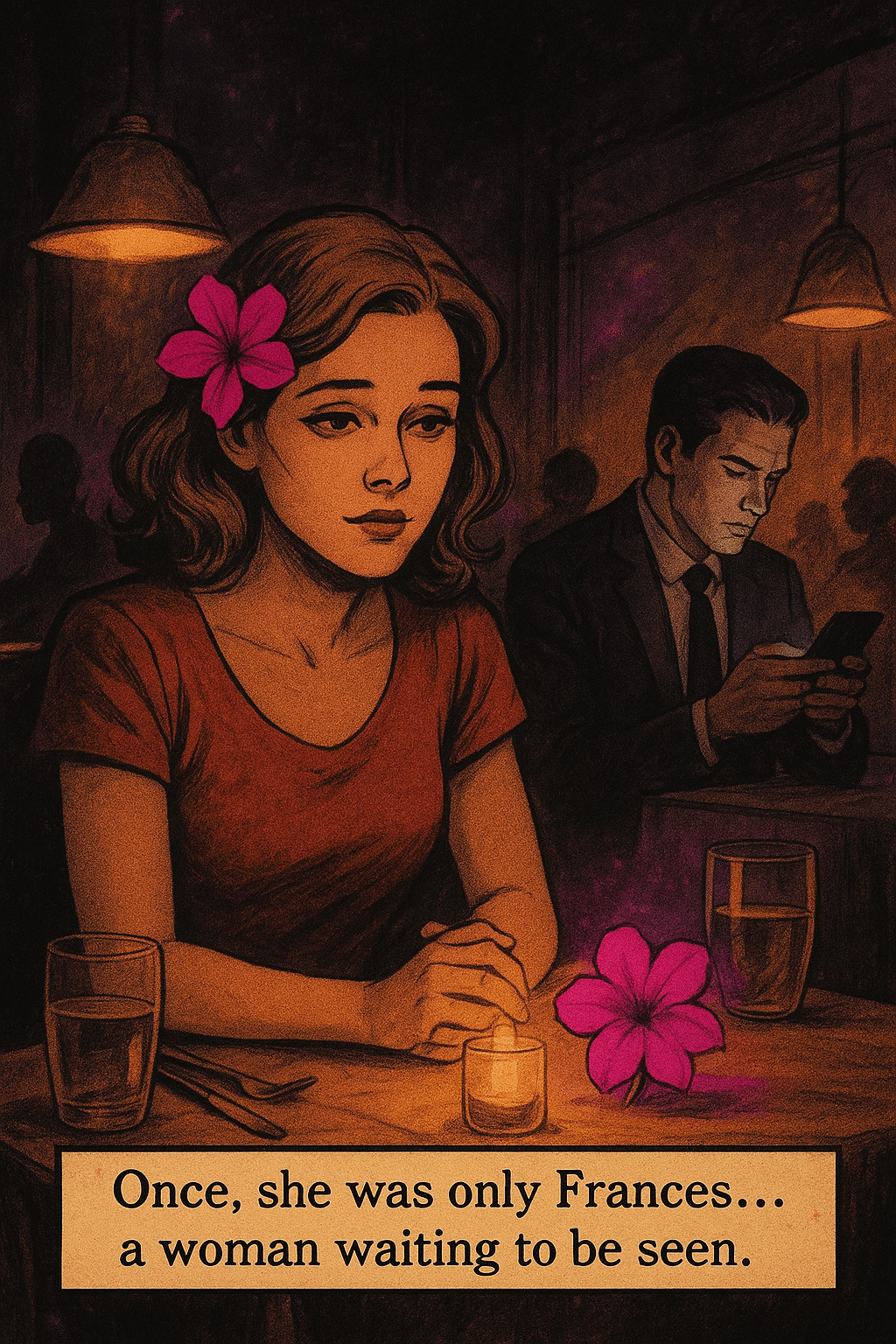
Frances was a sweetheart. Everyone said so.
She didn’t look anything llke the picture above, which was a new character in a Marvel film (Dick Diamond, Oracle 54; you’ve certainly read about it..?) Fuxia was Frances’s favorite.
Frances lived in Bandon. With Brandon. And was abandoned.
That’s the rhyme which played in her head, as she drummed her pen on her teakwood desk and looked out the window of the cafè, where you could see the streaming rain. Or was it the screaming rain? Because that’s what she felt like doing, primal therapy was it called? A gut wrenching yell would certainly clear her system.
Coquille Cafè was the name of her place of work, and since today was so terrifically rainy, even though it was August. She could barely see the Lighthouse across the River in the fog. It flashed day and night, and Fran found it comforting somehow. It was something to rely on, when it was so difficult to find, really.
She was doing the bills, and so she was doing them up by hand, feeling very 1950s and old-fashioned here with her round hemmed apron with her name embroidered on it and the selection of homemade pies under the front counter. But she wanted to be with Brandon, and there was only Mr. Fogherty in the corner, with his three strands of withered hair and his sad-sack eyes. A sweetheart. But a profoundly depressing companion on an already depressing day.
Frances, agian, was doing up the accounts and finding that the Cafè was a bit short of cash yet again. And her tips didn’t make up enough even for cat food, even though her cat (and her husband) seemed to be continually absent.
Suddenly she heard a trembling sound like leaves pulling off a tree, and with a woosh all the dirty cups on their tiny saucers clattered on top like a ghostly band, even though there was no wind which could enter the place. Frances saw a flash of violet light whisk through the place in a moment, and she jumped to her feet. Even Mr. Fogherty seemed to have awoken from his semi-daze.
“Oh! What the…” He craned his neck to look back at Frances with a quizzical expression, but she had scampered toward the window, where she was looking once again toward the lighthouse, where she could swear she could see a fuchsia coloured creature scrambling up the structure with leaps and bounds. It couldn’t be true, but it was, and if Frances could trust her wits which were usually reliable she could see a pair of bright pink heels on the being which seemed to work just fine on the slippery surface of the lighthouse, the Coquille River Lighthouse to be exact….
Brandon, oh, they all said to me. The women in the bars in the evening in Tillamook. Getting the cheese are you, Brandie, to bring back to wifey down south?
For some reason no one thinks I should be married, but why not? I’m a good provider, and I love Frances, and who’s to say being married is so terrible? She makes a mean peach cobbler, and she even knits me scarves and she tends to the house and when I do come home, I feel like a prince, you know what I mean.
Up here in Tillamook I have taken a house, and I admit I have a bit of a stray girlfriend here and there, but mostly there is just one. Tammy, is her name, and she happens to be one of Fran’s best friends, but I guess that sounds terrible. It all started last year, when City Hall put on a local talent show and Tammy decided to show up and put the rest of the contestants to shame with her long legs and her rizz, which is what people call charisma these days.
I’m telling you, she was incredible, and to be honest I don’t think I could have concealed my admiration for the girl if I had tried. To top it off, she singled me out in the crowd and ended up sitting in my lap with her short sequined skirt pulled up her thighs and pulled that incredible, smooth, movie star face next to mine and whispered something in my ear. Let’s just say Fran wasn’t too pleased about it, even though I was (and I had to cross my legs for the rest of the night because, well, she had a pleasing effect on my virility, you might say).
We’ve never slept together, not yet, but I have to say I was happy to accept the job in tillamook when I found out Tammy lived here and worked in a pole dancing school downtown. Maybe she’s not the type of girl to settle down and marry, but I’m not dead yet, so I figure looking at another woman isn’t a crime. Even taking her out to buy her the occasional latte isn’t bad either, so…
☕☕☕☕☕☕☕☕☕☕☕☕☕☕☕☕☕
Somehow Frances had found her way back to her three -room apartment, with the cute drapes she had made with green and white fabric which matched the checked rug in the living room in front of a real wood fireplace. She had fantasized about lying in front of it with Brandon before he had moved in with her. She imagined hugging him and snuggling into his firm chest and playing with his dark wavy hair and grey eyes, which reminded her of the Pacific Ocean. But it all been a sham. And now she was here, making herself a chai on the gas stove and searching for cinnamon sticks and listening to the surf smash against the shore.
Then, a terrible cry. Half woman, half electrical power surge. And a shockwave which threw Frances to the floor and filled the room with a purple -pink light.
The next morning, when Brandon came home, he found the apartment empty. There was, however, a strange purplish glow, like fog. He checked the lights until the fuse snapped, sending violet sparks which made him jump.
Where had she gone?
-

(Intro)
I’ll never forget looking through one for the first time, and seeing the world all broken up into little symmetrical pieces. It’s a little like life is, all the confusion, all the panic, all the beauty.
And so it is, I have finally decided to write, and to pass along my third eye downloads from the stars. It took a long time in the galaxies with Google maps to get to earth, so these flashes of inspiration are the memory of where I came from, where we all came from…
-

She told herself it was just a mistake, meeting him. She told herself that, and she knew it was true as well, but she just wanted to believe it was false, because she knew she could never give him up.
Trixie had a pretty cool life, even with a silly name like that. It was short for Beatrix, “she who brings happiness.” And she did, because she really liked socializing, and she had a pleasant demeanor, said her Greek boss. (Such an old-fashioned way of putting in but also charming, she thought). Waiting tables was good for meeting people, and in Portland there were lots of cool people; musicians, artists, body workers, businessmen. Some homeless people too, of course. Because Portland was a kind and caring place they would end up getting free coffee and a chance to share their stories, sometimes even sing at open-mike night as her boss Dmitris was a caring guy.
She wanted to tell the story to her therapist of exactly how she discovered that Anthony was up to no good, but she couldn’t bring herself to do it, because she knew she would start crying and then it would be clear that the brave strong Trixie was a sham. She had taken on her colorful nickname and her shiny clothes just to seem tough, but it wasn’t true. She wanted true love and she fell into every trap.
You know those days when it has just snowed and there’s sun and you would think that even your thoughts or feelings might break up that golden world of perfection all around? That winter wonderland which seems to cloak even your insides? There was a silence, a feeling of preciousness in the air. That was the day when she thought of Anthony for the first time, when she was alone after her shift and she had to clean the espresso machine and she looked out the window at the snow and suddenly she could see his face, and his upper lip which looked like he had gotten hurt as a child. It had a tiny little bump which she found to be the height of sensuality.
Funny how sometimes people seem so beautiful when they are really ugly. She thought of this afterwards, when it was all suddenly finished as if it had never begun. A blip in space time doomed to endless impossibility.
Used. That was how she felt later. Like the coffee grounds when all the flavor had been sucked out of them.
He used to come into the bar with his girlfriend, Susan. She had brown curly hair and looked very independent and opinionated and had a lot of bracelets with chakra symbols on them. She took control of ordering, looking deep into Trixie’s eyes to see if she wanted her boyfriend. Trixie recognized that look, as all coupled up men had women leading them around like prize bull steer. They couldn’t waver, couldn’t flirt, couldn’t even speak to the waitress, it seemed, without consequences.
The worst women were the ones who made friends with you, because then when you were on a first-name basis with them they would turn on you and become cold frosty bitches. All the worse for them, Trixie thought. (All very ironic that in the end, she became just like them, too).
Anthony had been in a rock band, but now he was into economy and was always chasing down the next investment on his iphone. He wore more preppy clothes now. That day that Trixie remembered, he was wearing a dark green sweater. Like his eyes, which were the frosty green of Ireland, always absent, as if lost in the fog. Had tousled dark hair which reminded her of Timothy Chalamet. Susan ordered an almond milk latte and Anthony a plain espresso in a glass, which he preferred. Susan sometimes got a cookie as well, but seemed angry if Anthony didn’t order one too. She seemed more like his mother than his girlfriend, Trixie thought.
When Anthony came to pay, Trixie noticed that he had little gold flecks in his eyes and long eyelashes. He caught her looking but didn’t smile. He seemed more distracted that anything else.
He handed her his visa, but the connection wasn’t working, and in the meantime Susan had come up behind his shoulders, glancing at Trixie with an evil stare. You could feel the tension in the air as she listened in to their conversation as if she was 007. She was pretty odd-looking, thought Trixie. Short legs, bad taste in clothes (an orange tube top with a green skirt, Austin Powers style).
Susan, on the other hand, thought of Trixie as an empty-headed lush. Yes, she was objectively pretty, but she always mixed up the orders and seemed to be constantly staring at Anthony. Who wouldn’t? Anthony was the little lost soul that women loved to take care of, serious and yet raw, something elusive about him.
The cash register clanged shut as the couple left and Trixie went back to her station. Coffee grounds, that was all she had to look forward to, she thought.
A few months later, Anthony came back into Dante’s (the bar where Trixie worked), this time alone. She tried to remain calm as she scoped him out, skinny and respectful and oh-so-handsome now (maybe he had been going to the gym, she hadn’t remembered him so built). This time, he was alone.
When he asked for the wi-fi password, he looked at Trixie as if for the first time. She had gotten skinnier, and was wearing a grey sweater which fit her badly. She had taken off her nose rings and had stopped wearing patchouli. She looked more beautiful than before, he thought, less dolled up, more simple. She had shadows under her eyes and her hair was a bit longer now, brushing against her shoulders in uneven clumps. No jewelry.
“Thanks so much! What do I owe you?” Anthony smiled for the first time, revealing a sweetness about him which was still relatively subdued. He obviously wasn’t the type to make overt declarations of any kind. His eyes, she thought, had a touch of hunger to them as well, as an underfed animal might have.
Trixie, or Beatrix as she was now called, was vaguely aware of a jolt of confusion every time she saw him. But she wanted it to go away. She knew what it meant.
They ended up going out, and he ended up dumping Susan. There were even a few awkward moments when his ex came into the bar while Anthony was there chatting up Beatrix, but after feigning interest in a cookbook and scowling in their direction, she left. Anthony and Beatrix had a great time together for exactly 21 days, until their relationship relapsed into the same condition as his previous one. Gone were the hurried kisses and the make-up sex and the fun evenings out dancing (she liked underground music, and he went just to humor her) or smoking weed (he was a fan, even though it didn’t work out so well when you had to crunch numbers for investors the following day). Gone in a flash and somehow, she felt as though she had become Susan, that stick-in-the-mud, basic bitch. That ball and chain. She could feel her own face morphing as her character began to transform as well.
She had that sense that he wasn’t really concentrated, that he wasn’t really interested anymore. When they went out to coffee, he would look up from his phone with a vaguely irritated expression, as if speaking to a servant. Of course, asking what he was looking at was counter-productive.
“What?” this was his question if she disturbed him. She would pause, searching for the right way to ask him how she had become that which she had most deeply feared, but certainly the question itself made no sense, so she kept silent. When the waitress showed up, a gentle girl right out of high school, with a black apron and sincere eyes, Beatrix knew that she was about to be passed over for the next best thing.
“Are you ready to order?” At these commonplace words Anthony looked up as if a fairy princess had spoken, his eyes wet with anticipation.
Beatrix felt futile rage mounting in her chest like bile, felt hideously ugly for just a moment, used up, broken. She had to almost physically control herself.
“Just a black coffee for me, thanks,” she spoke in a husky, bitter tone.
“No one is interested in fresh cinammon rolls are they?”
As she turned her face to Anthony, Beatrix could see the excitement in her eyes, the false ingenuity.
Looking out the window, she saw the first drops of spring rain settling on the pine trees, perfectly still and balanced on the tips of the needles. That was how it was, she thought. Life just pierced you, through and through. And you had to go on as if nothing happened.
“Yes, I’ll have one!” The waitress and Anthony seemed startled as she put in her dibs for a nice pastry. Sweets were always comforting, she thought.
Even in hell.